Engineering Food Security: Controlled Environment Agriculture (CEA) in the UAE and Saudi Arabia
Salimus is expanding its sustainability and building-performance expertise into Controlled Environment Agriculture (CEA), vertical farming and indoor farming — combining energy modelling, HVAC performance, water efficiency, commissioning and regional sustainability expertise for projects in the UAE, Saudi Arabia and the wider GCC.
What Is Controlled Environment Agriculture (CEA)?
Controlled Environment Agriculture (CEA) is the production of crops in environments where conditions such as temperature, relative humidity, lighting, airflow, irrigation and nutrients are actively managed. CEA includes vertical farming, indoor farming, hydroponics, aeroponics and advanced climate-controlled greenhouse systems.
For the UAE and Saudi Arabia, these technologies are particularly relevant because they can support year-round local food production while reducing dependence on arable land and improving water efficiency. The UAE’s food-security guidance specifically identifies vertical farming, hydroponics and controlled-environment agriculture among the technologies being used to strengthen local agricultural production, while Saudi research and government-backed initiatives are also advancing CEA, hydroponics and vertical farming for hot, water-scarce conditions.
Why CEA Matters for Food Security in the Gulf
Food security in the Gulf is increasingly an engineering challenge. Extreme summer conditions, limited freshwater resources, constrained arable land and the need for resilient supply chains are driving investment in agritech, smart farming and sustainable agriculture.
Vertical farms and other CEA facilities can produce selected crops close to consumers in controlled conditions throughout the year. However, the success of a commercial indoor farm depends on much more than crop technology. It depends on the performance of the building, HVAC and dehumidification systems, lighting, irrigation, controls, water recovery, electrical infrastructure and commissioning.
This is where Salimus brings a distinctive capability: integrating building-performance engineering and sustainability with the operational requirements of controlled food production.
Salimus Vertical Farming Experience in Abu Dhabi
Salimus has direct project experience on a major vertical farming facility in KEZAD, Abu Dhabi. The project involved adapting an existing warehouse of approximately 18,000 m² to accommodate a multi-level indoor farming operation, creating a highly controlled production environment within an existing industrial building.
The planned facility incorporated germination areas, grow rooms, crop harvesting, food packing, material storage and cold storage. Salimus’s scope included Estidama Pearl Qualified Professional (PQP) services, Independent Commissioning Agent (ICA) services, sustainability coordination and energy modelling.
Our work addressed the interaction between the agricultural process and the building: energy performance, water management, lighting, ventilation, process loads, indoor environmental conditions, commissioning, materials and waste. The project also required close attention to electrical capacity, drainage, fire and life safety, smoke management, structural support, access, HVAC, controls and the implications of a box-within-a-box vertical-farm configuration.
Vertical Farm HVAC, Dehumidification and Environmental Control
HVAC is one of the most important systems in Controlled Environment Agriculture. In a conventional building, HVAC primarily maintains conditions for occupants. In an indoor farm, the HVAC and environmental-control systems become part of the production process.
Plants transpire moisture into the air, while LED grow lighting and equipment add sensible heat. Temperature, relative humidity, airflow, irrigation, nutrients and — where applicable — CO₂ concentration interact continuously. Maintaining the correct conditions across multiple crop levels requires careful psychrometric analysis, air distribution and control.
In Gulf climates, inefficient cooling, dehumidification and reheat strategies can create a substantial energy penalty. CEA engineering therefore needs to consider cooling and latent loads together, including heat recovery, dehumidification efficiency, airflow, pressure relationships, sensor locations and controls.
Energy Modelling for Vertical Farms and Indoor Farming
Energy modelling for a vertical farm is different from modelling a conventional office or residential building. Lighting and process loads can be very high, operating schedules are crop-driven, and HVAC energy is strongly influenced by plant transpiration and humidity control.
Salimus can use energy modelling to assess alternative HVAC strategies, lighting loads, operating schedules, envelope performance, ventilation, heat recovery, renewable energy and control sequences. The objective is not simply to reduce annual building energy use, but to improve energy efficiency per unit of food produced.
For commercial CEA projects, useful performance indicator scan include kWh per kilogram of produce, litres of water per kilogram, kgCO₂e per kilogram, renewable-energy contribution, condensate-recovery rate and crop yield per unit of conditioned growing volume.
Water Efficiency, Hydroponics and Condensate Recovery
Water efficiency is one of the strongest drivers for hydroponics and controlled-environment farming in the Middle East. Hydroponic systems recirculate nutrient-rich water, while the controlled indoor environment creates another important opportunity: recovering water from the air.
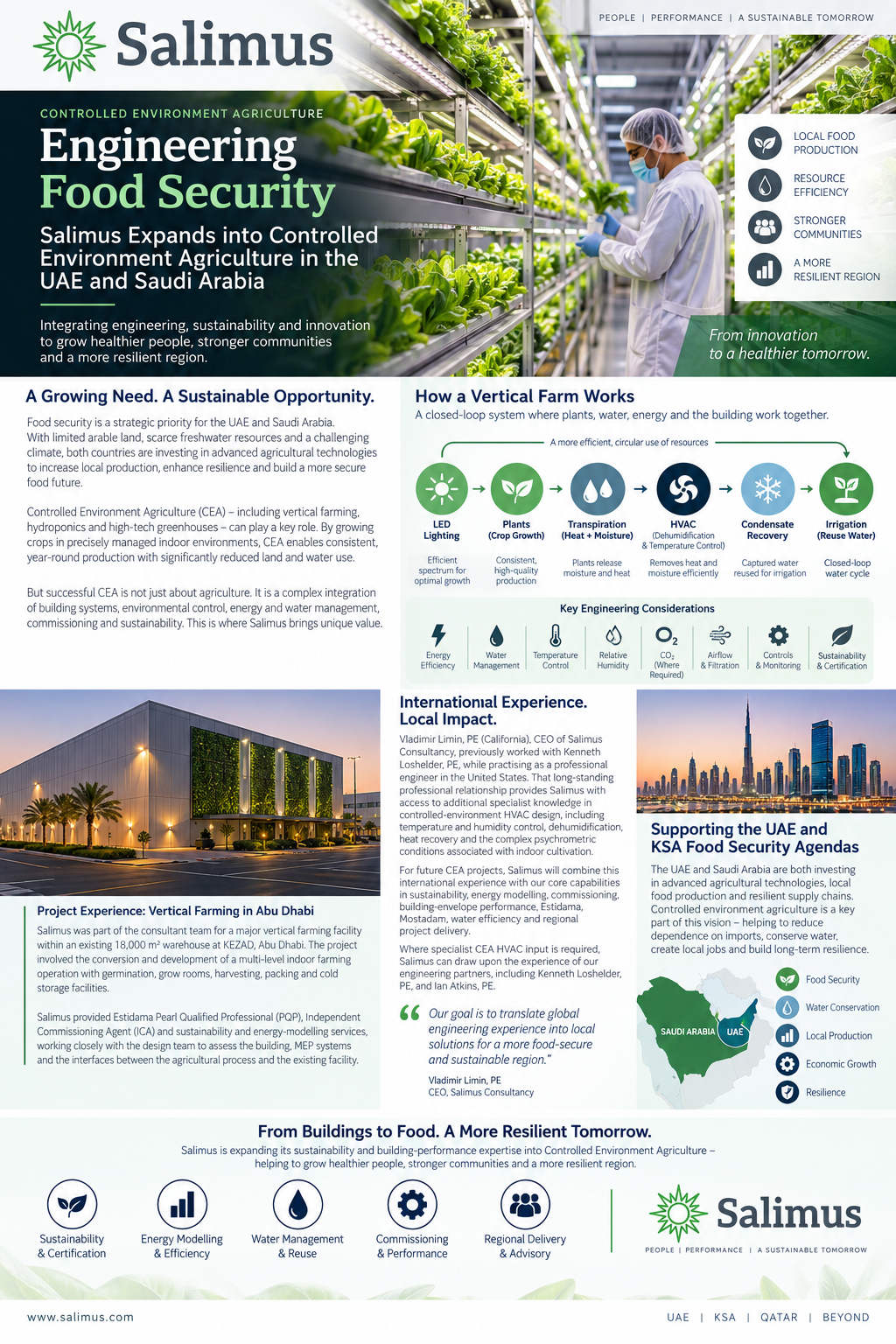
A useful way to view the CEA water-energy cycle is: LED lighting → crop growth → transpiration → heat and moisture →HVAC/dehumidification → condensate recovery → irrigation.
By considering HVAC and irrigation together, designers can evaluate how much transpired water can be captured and reused, how water quality should be managed and how the energy required for moisture removal can be reduced. Salimus can support water balances, condensate-recovery strategies, metering and resource-efficiency assessment.
Commissioning and Building Performance for CEA Facilities
Commissioning is critical in vertical farming because a system may be operational without providing stable crop conditions. Variations in temperature, relative humidity, airflow, irrigation, controls or sensor calibration can affect crop consistency, disease risk, yield and energy consumption.
Salimus can provide independent commissioning and performance verification for HVAC, dehumidification, BMS and controls, sensors, alarms, metering, heat-recovery systems and the interfaces between building and process systems.
Building-envelope commissioning and airtightness testing are also relevant. Uncontrolled air leakage can add sensible and latent loads, disturb pressure relationships and make precise temperature and humidity control more difficult. Salimus’s established envelope-testing capability therefore complements our CEA engineering services.
International Experience, Delivered Through Salimus
Salimus’s expansion into CEA also builds on long-standing professional engineering relationships in the United States. Vladimir Limin, PE(California), CEO of Salimus Consultancy, previously worked with Kenneth Loshelder, PE, while practicing as a professional engineer in the United States.
That strong professional relationship gives Salimus access to additional specialist experience in controlled-environment HVAC, including temperature and humidity control, dehumidification, heat recovery and the psychrometric conditions associated with indoor cultivation.
For future CEA projects, Salimus will combine this international specialist knowledge with our own capabilities in sustainability, energy modelling, commissioning, building-envelope performance, Estidama, Mostadam, water efficiency and regional project delivery. Salimus remains the regional client-facing engineering and sustainability platform for this service.
CEA Engineering Services from Salimus
• Controlled Environment Agriculture(CEA) sustainability and engineering strategy.
• Vertical farm and indoor farm energy modelling.
• CEA HVAC, cooling, dehumidification and heat-recovery performance review.
• Hydroponic and CEA water-efficiency, condensate-recovery and reuse strategies.
• Independent commissioning and performance verification.
• Building-envelope commissioning and airtightness testing.
• Estidama, Mostadam, LEED and applicable sustainability certification support.
• Energy, water and carbon performance benchmarking.
• MEP and design reviews focused on integration between crop systems, environmental controls and the building.
• Technical advisory and regional project delivery in the UAE, Saudi Arabia and the wider GCC.
Controlled Environment Agriculture for the UAE, Saudi Arabia and GCC
CEA will not replace conventional agriculture or international food trade, but it can become an important part of a diversified food-security system. The strongest applications are likely to be those where controlled production, proximity to consumers, crop quality, water efficiency and supply-chain resilience justify the additional engineering and energy requirements.
Salimus is bringing its established expertise in sustainable buildings, energy, water, commissioning and building performance into this growing sector. Our objective is to help developers, investors, operators and design teams create CEA facilities that are not only capable of growing crops, but are measurable, efficient, resilient and engineered for Gulf conditions.